
Searching for “3D scanning services near me” usually means you have a part, mold, or prototype that needs to be 3d scanned. Local providers have made the technology widely accessible, and many now offer advanced systems. These systems capture the shape and size of real-world objects quickly and without damaging them. But a scanning service and a metrology partner are not the same thing. A decent, professional company will deliver accurate, repeatable data which will support inspection, reverse engineering, and production decisions.

Why Choose a Local 3D Scanning Service?
Working with a nearby local provider simplifies logistics. You can bring a part to the shop, and discuss the project in person. As well, you avoid the risk of shipping fragile parts or tooling. Many providers also offer mobile on-site service for large or installed equipment. Turnaround is often faster because of no travel involved, and local partners usually also provide related services like CAD modeling, inspection, and 3D printing, all in the same facility.
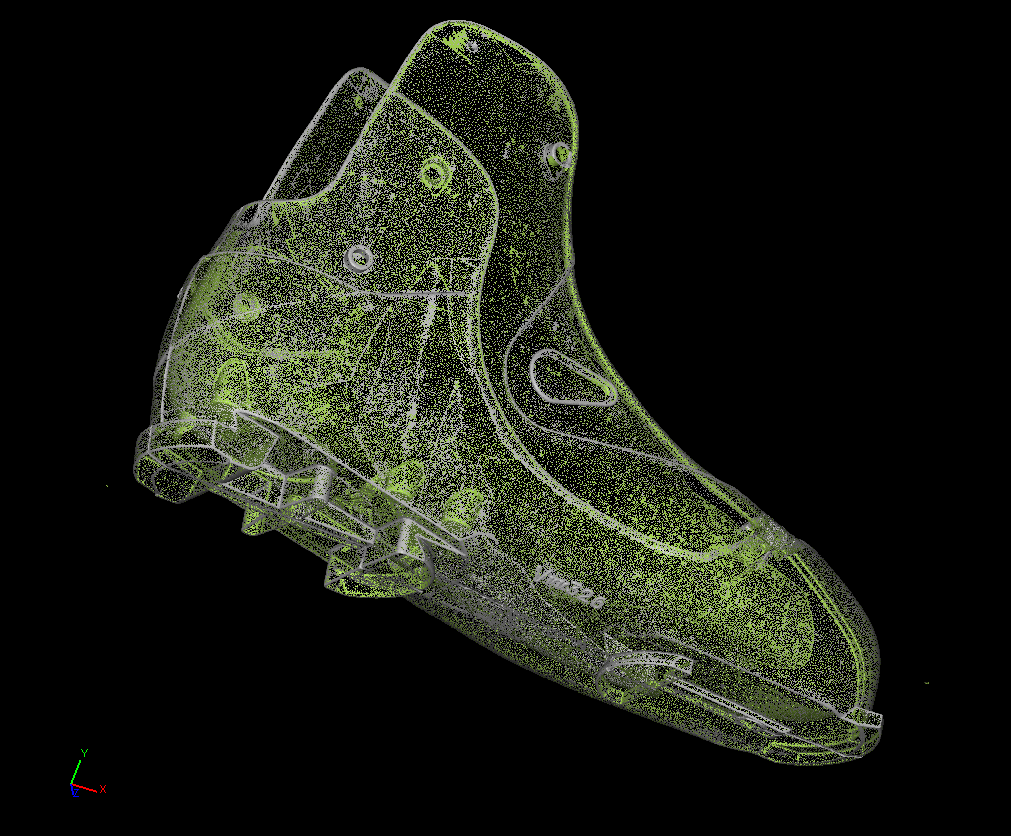
What is the ideal technology that a 3D Scanning/Metrology Partner should offer?
Professional 3D scanning spans several technologies, and a well-equipped provider will have more than one type of digitizing machine. The right approach depends on the size, geometry, material, and accuracy requirements of the part. A provider with a range of different 3d scanners can recommend the best technology for your project.
Blue Light and White Light Scanning
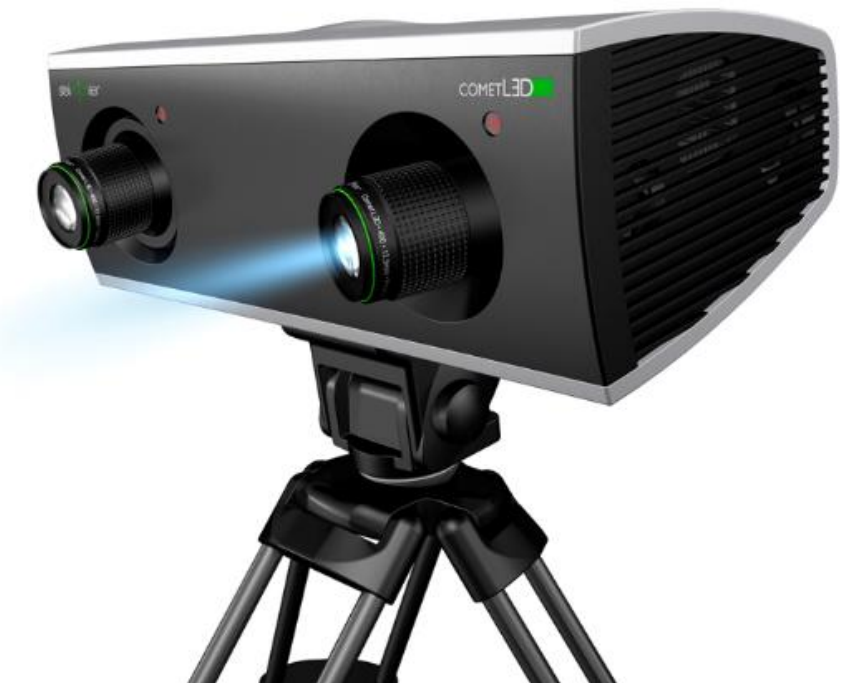
Blue light and white light systems project structured patterns onto the surface of a part and use cameras to read how those patterns deform. The result is a dense point cloud containing millions of points. These methods are quick, accurate, and non-destructive, which makes them a strong option for complex surfaces, mold tooling, and organic shapes. Digital twins created this way give engineers a complete picture of a part for analysis or documentation.
Laser Scanning and Portable CMMs
Laser scanning records points across a surface and is well suited to large parts and production floor environments. Portable CMMs bring measurement capability directly to a part when moving it to a lab is impractical. Combining a portable arm with a laser scanner lets a technician capture geometry on site using contact and non-contact methods. This flexibility adds ease of use and accuracy for parts of almost any size.
CT Scanning
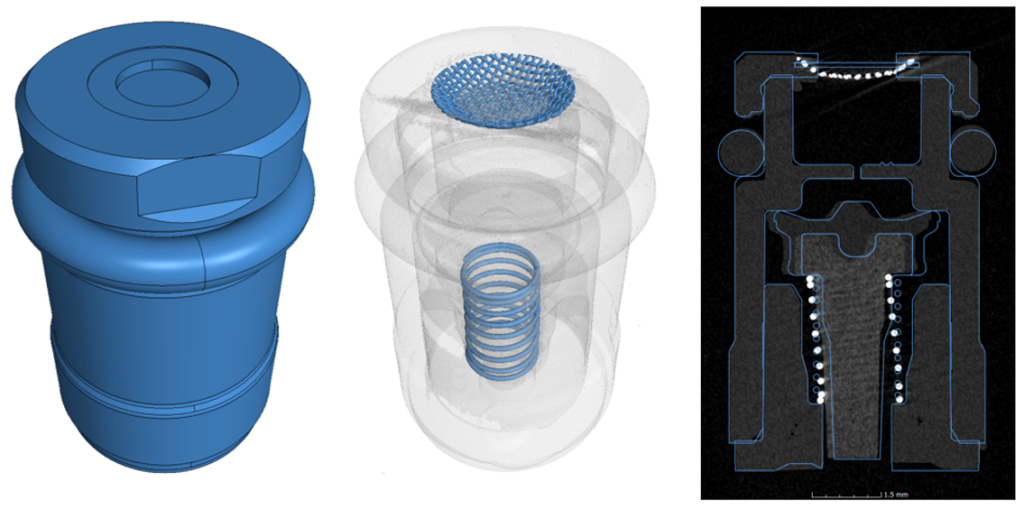
CT scanning captures internal and external geometry, making it the perfect choice for parts with hidden features or internal channels. It uses X-rays to capture hundreds of images, and combines them into a 3d point cloud containing millions of points, each having x,y,z coordinates. A partner with CT capability can deliver data that a simple handheld scanner cannot.
What to Look for in a Metrology Partner
Hiring a scanning provider for metrology work is different from hiring someone to digitize a hobby object. The output data is the input for engineering and manufacturing decisions. What to look for in your service provider:
Accuracy and repeatability: Equipment must hold high precision, and results must be consistent from scan to scan.
Inspection experience: The provider should support part-to-CAD comparison, GD&T, and SPC reporting.
CAD-ready output: Deliverables must include a range of file formats, like STL, STP, IGES, Parasolid, SLDPRT, etc.
Reverse engineering skills: Converting scan data into usable CAD models takes experience, especially with blow molds, organic parts, and spare parts.
In-house follow-on services: Scan-to-print, CAD modeling, and 3D printing under one roof shorten project timelines.
On-site capability: Mobile scanning matters for parts that are large, heavy, or sensitive.
Inspection and Quality Control
A metrology partner treats scanning as a measurement process. Leading metrology companies offer 3D scanning services that are highly accurate and repeatable for both inspection and calibration needs. A good provider should be able to compare scanned data to the original CAD model and report the differences in a usable format. When you search for 3D scanning services near me, ask whether the provider can produce part-to-CAD comparisons, geometric dimensioning and tolerancing, and statistical process control reports.
Reverse Engineering and CAD Modeling
Scanning captures the surface of a part, but reverse engineering rebuilds that surface into a model you can edit and manufacture. This is where provider experience comes in. A raw mesh cannot be modified in a CAD system. Nor can it be machined directly. So, the 3D Scanning company must reconstruct the part with feature based modeling and provide solid, water-tight geometry. Companies that work with blow molds, organic objects, and obsolete spare parts understand design intent in a way a general scanning shop may not. Ask for examples of reverse-engineered models that went to production.
File Formats and Workflow Integration
Scan data is only useful if you can use it directly. A good provider offers a range of file formats so the model works in your design, simulation, or inspection software without conversion work. CAD-ready files are especially important when the part will be modified, machined, or 3D printed. Confirm the deliverable format before the project starts. And also verify that the 3d scanning provider company can export the native or neutral CAD formats your team can use.
Questions to Ask Before You send a Purchase order or Payment
A few direct questions will separate a true metrology partner from a general-purpose scanning shop. Ask these before you approve any quote.
- Which scanning technologies do you have in-house, and which do you recommend for my part?
- What accuracy and repeatability can you guarantee, and how is it verified?
- Can you scan on site at our facility?
- What file formats will I receive?
- Do you provide inspection reports with part-to-CAD comparison, GD&T, and SPC?
- Can you reverse engineer the scan into a solid CAD model?
- Do you also offer 3D printing or short run production?
- What does the scope of work in the quote include?
How a Typical 3D Scanning Project Starts
Most professional services follow a similar process. You complete a contact form or call to describe the part and its purpose. The provider contacts you to discuss the scanning needs and provide pricing. After you approve the scope, the scan happens in-house or at your location. The data is processed, aligned, and converted into the agreed deliverables, and the results are reviewed before the project closes. Pay attention to providers who ask how the data will be used, because the strategy for inspection differs from the strategy for reverse engineering or prototyping.
Common Applications for Local 3D Scanning
3D scanning serves far more than one industry. The same technology that scans a sculpture can verify a production mold or capture a prototype. Common downstream applications of 3D Scanning include quality control, reverse engineering, prototype development, and digital documentation.
- Quality control and part-to-CAD inspection
- Reverse engineering of blow molds, organic objects, and spare parts
- Prototypes, props, sculptures, and physical models
- Digital twins for documentation and analysis
- Scan-to-print workflows for 3D printing
- Short run production of replacement parts
For manufacturers and mold makers, combining scanning with inspection and printing is especially valuable. A provider with multiple 3D printing technologies, including FDM, Polyjet, SLS, SLA, DMLS, and metal printing, can move a project from scan data to a finished part without multiple vendors. That reduces lead times and keeps the data consistent under one roof.
Finding the Right Provider Near You
3D scanning services are available in most major manufacturing areas. Industrial buyers should look for engineering experience and a strong track record. Applications 3D has been in business since 2003. The company has completed thousands of projects. It is based in Metro Detroit. Applications 3D serves manufacturers, mold makers, and engineering firms. Its services include 3D scanning, reverse engineering, digital metrology inspection, CAD product design, and 3D printing prototyping. The company uses blue light, white light, laser, CT scanning, portable CMMs, and digital optical profilometers. Short run production is available for parts that need CNC machining, molding, stamping, or welding.
Frequently Asked Questions
How much do 3D scanning services cost near me?
Pricing depends on the size, weight, and complexity of the item. We ask you to describe the part and its intended use before giving pricing. Why? Because there are different levels of 3D Scanning, Reverse Engineering and Inspection. Without relevant usage information, a quote might not cover the kind of models needed . No single glove fits all projects. Ask for a detailed quote that covers scanning, processing, and any reverse engineering or inspection reporting.
What file formats should a 3D scanning service provide?
A professional provider should deliver files that integrate into existing workflows. This may include CAD-ready models and a range of standard 3D file formats. If the part will be machined, printed, or modified, confirm that the provider can convert the scan data into a solid CAD model rather than just a mesh. Ask about native and neutral formats before you approve the project.
Can a 3D scanning provider work at my facility?
Many providers offer mobile on-site service for parts that are too large, heavy, or sensitive to ship. On-site scanning reduces downtime and protects the part from transit damage. Portable CMMs and laser scanners are commonly used for this type of work. Ask whether the provider can bring equipment to your location and whether there are any minimum project requirements for on-site service.
How accurate is professional 3D scanning?
Professional 3D scanning systems are built for high accuracy and repeatability. Advanced providers support both inspection and calibration needs. In quality control, scanned data can be compared directly to a CAD model to quantify deviation. The actual accuracy depends on the technology, the part size, and the operator’s skill. Ask the provider to share equipment specifications and examples of inspection reports.
Do I need a 3D printer to use a 3D scanning service?
No. Many scanning providers also offer 3D modeling and 3D printing, so you can receive finished parts or prototypes without owning any equipment. Some services advertise scan-to-print workflows, where scan data moves directly into production. Providers with in-house printing technologies such as FDM, Polyjet, SLS, SLA, DMLS, and metal printing can deliver end-use parts or prototypes from your scan data.