
Many aerospace programs rely on parts designed decades ago. Some of those parts were made before modern CAD software existed. Others have design files that were lost, damaged, or never fully recorded. When a legacy part fails, the original drawings may be missing. The original tooling may also be gone. Reverse engineering legacy aerospace parts has become a practical way to keep older aircraft flying. It also supports systems that no longer have an active supply chain.
Reverse engineering means taking apart a physical part to learn its design. For parts like a turbine disk or fuel nozzle, the goal is to capture the design data. That data can then be used to remake the part or to build a better version. In aerospace, this method is used for parts that lack full engineering details. When no CAD file exists, engineers use measurement, modeling, and reverse engineering to create a working replacement.

Why Legacy Aerospace Parts Are Difficult to Replace
The average age of US military aircraft is more than 20 years. The avionics systems on these planes are getting more expensive to maintain and operate. The problem often comes down to a few parts inside these older systems. These parts are not very reliable and cost a lot to repair. Repair costs go up because the parts are old, which makes fixes harder. Replacement parts are either very costly or not available at all.
The same issue shows up in commercial, general aviation, and defense fleets. Older machines, tools, and parts are often so old that CAD files were never made. Or the files have been lost over time. Without the original design documents, engineers face a slow process. They must capture part data, rebuild models, and check that the replacement meets the needs of the application.
How Reverse Engineering Works for Legacy Aerospace Parts
Reverse engineering a legacy aerospace part is a process that moves from physical measurement to a digital CAD model . The workflow depends on the condition of the part, the availability of documentation, and the intended use of the replacement.
Capturing the Geometry
The first step is to capture the shape of the existing part. 3D scanning is a common method. It records complex surfaces and details quickly. Laser scanning works well on legacy aerospace parts that lack full engineering drawings. Sometimes, portable scanners are brought to the aircraft. This avoids moving large or delicate parts.
Scanning captures the physical shape, but not everything. The scan data is a dense point cloud. It must be cleaned, aligned, and turned into a usable digital form before it can support manufacturing.
Reconstructing the CAD Model
Once the scan data is collected, the next step is to rebuild the shape in CAD software. For aerospace parts, this often means resurfacing the scanned data in a strong CAD program like CATIA or UNIGRAPHICS NX. The goal is to make a model that shows the original design intent, not just the current state of a worn or damaged part.
Here, engineering judgment matters. A scanned part may show wear, bending, or past repairs. The engineer must decide which features are original and which are flaws. The rebuilt model should show the part as it was first designed. Tolerances and surface finishes that fit the part’s use are also key.
Qualification and Traceability
Creating a digital model is only part of the work. Aerospace parts must be qualified and traceable. The real challenge is everything around the shape: missing documents, unknown materials, no process history, no traceability, and no qualification data. Without these, a model that is perfectly shaped may still be hard to certify for flight.
Engineers must identify the material, confirm the manufacturing process, and record the inspection results. This information is needed to make a part that can be approved for use. Extra testing may be required to prove the replacement works as well as the original.
Manufacturing the Replacement Part
After the CAD model is complete and verified, the part can be manufactured. Reverse engineering and additive manufacturing techniques, like 3D Printing, have been used together to bridge the gap between obsolete parts and modern performance. Additive manufacturing can produce complex geometries. These are difficult or impossible to make with traditional machining.
Creating new legacy parts often requires reverse engineering of an existing legacy part. Once the digital model exists, the part can be made through various manufacturing routes. These include CNC machining, molding, stamping, welding, and additive processes. The right choice depends on the material, quantity, and the performance requirements of the component.
In some cases, new tooling must be fabricated before the part itself can be produced. This is common when the original molds or dies no longer exist. The scanned data and CAD model provide the basis for creating that tooling, which makes it possible to manufacture parts that were previously unavailable.
Applications Across the Aerospace Industry
Reverse engineering is used in multiple segments of the aerospace industry. Companies that fabricate parts for the legacy and warbird markets rely on these techniques to support aircraft that are no longer in production. These same companies can also produce approved components for modern aircraft, which shows that the methods are not limited to old airframes.
Legacy Avionics Components
Avionics present a special case. The average age of US military aircraft is more than 20 years, and avionics systems are becoming more expensive to maintain. Legacy avionics components often have low reliability and high repair costs. Reverse engineering and re-engineering techniques have been used to replace these low-reliability components. In this context, re-engineering may involve updating the design to use modern materials or electronics, rather than simply copying the original part.
Warbird and Museum Aircraft
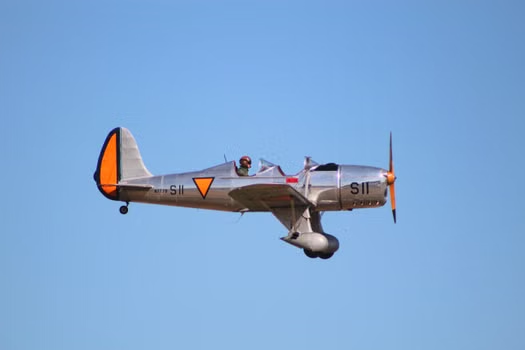
Restoration projects for warbird and museum aircraft face constant parts shortages. Original manufacturers no longer support these decades-old planes. Reverse engineering creates authentic replacements from surviving aircraft, keeping historic planes flying for future generations.
C hallenges Beyond the Geometry
 hallenges Beyond the Geometry
Reverse engineering legacy aerospace parts sounds simple on paper. Scan the part, rebuild the shape, and print it again. In reality, that is usually the easy part. The real challenge is everything around the shape: missing documents, unknown materials, no process history, no traceability, and no qualification data.
These gaps affect every stage of the project. Without material data, an engineer cannot confirm that a replacement will handle the same loads and temperatures. Without process history, there is no record of how the original part was heat-treated or finished. Without traceability, the component cannot be tracked through its service life. Each of these issues must be solved before the replacement part can be accepted.
The solution is to treat reverse engineering as an engineering project, not just a scanning job. The measurement data must be combined with materials analysis, design review, and inspection planning. This approach produces a part that is shaped like the original and also documented and qualified for its intended use.
In practice, this means the scanning phase is only the starting point. Engineers must identify the alloy or composite through laboratory testing, verify that the geometry meets the original design intent, and plan how the new part will be inspected during production. The result is a replacement that carries the same engineering confidence as the original, not just a similar-looking object.
Best Practices for Reverse Engineering Legacy Aerospace Parts
Several practices can improve the outcome of a legacy part reverse engineering project. First, start with the most serviceable example available. A part in good condition gives better reference data than one that is heavily worn or repaired. Second, use multiple measurement methods when possible. A laser scan captures the overall shape, while a coordinate measuring machine can capture critical features with higher accuracy.
Third, document every assumption. When the original drawings are missing, the engineering team must make choices about tolerances, materials, and finishes. Record those choices for future work. Fourth, check the CAD model against the physical part before manufacturing begins. A part-to-CAD comparison can reveal errors while there is still time to fix them.
Finally, plan for qualification early. Waiting until the part is made to think about traceability and testing causes delays. Identify the material, the inspection plan, and the acceptance criteria at the start of the project.
Reverse engineering legacy aerospace parts for manufacturing is a practical answer to a problem that will not go away. As fleets age and original suppliers move on, the ability to capture a physical part, rebuild its design data, and manufacture a qualified replacement becomes more valuable. By combining 3D scanning, careful CAD reconstruction, and modern manufacturing processes, companies can keep legacy systems flying and reduce the cost and lead time of hard-to-find components.
Frequently Asked Questions
What are reverse engineered legacy aerospace parts?
Reverse engineered legacy aerospace parts are replacement parts made by copying the shape and design of an original part that has no full paperwork. The process uses 3D scanning to capture the form, CAD modeling to rebuild the design, and manufacturing methods to create the new part.
Why is reverse engineering used for obsolete aircraft parts?
Many aerospace systems use parts that are no longer made. The average US military aircraft is over 20 years old. Many older avionics parts are costly to fix or cannot be found. Reverse engineering builds a digital model of an existing part. That model can then be used to make the part when needed.
What is the difference between reverse engineering and re-engineering?
Reverse engineering captures the design data of an existing part and reproduces it. Re-engineering goes further. It improves the design, such as using modern materials or updated electronics. This can replace a low-reliability legacy component while keeping the same form and function.
Can additively manufactured parts be used in aerospace?
Additive manufacturing helps aerospace teams replace legacy parts and run small production batches. It can create complex shapes that traditional machining struggles to make. Parts can be built on demand. However, each part still needs to be qualified. Its material and process must be documented for the intended use.